It's a bit muddy out at Mill Rythe where Hayling Yacht Company is so with a deep fin keel we need a spring tide to be able to get out into the main channel. The next full moon is on Thursday the 25th so the following weekend is ideal to get Lively Levante over to Chichester; the high tide is 5 metres at 1pm, perfect!
The only difficulty is that there is still rather a lot to do before we can get her into the water and seaworthy. I've managed to finish off the electrics and electronics, so we have an echo sounder now which is highly desirable. The instruments all worked immediately on switch on, the NMEA 2000 bus is fantastic compared with all the faffing about that was needed to make the earlier systems work. The yard need to finish off the installation of the cooker,
install the anchor winch and re-spray the stern; good job the weather forecast is for dry conditions so this should be complete in the next couple of days.
The main priority though is to crane the engine back in together with the mast. The engine should be straightforward as all the ancillaries are there, it's just a matter of shiming up the engine mounts to get the shaft alignment right so that the SureSeal will do it's job and keep the water out. The Mast is more problematic with several key parts we still need that could delay hoisting it. The first problem was the furlex, which was in short supply; fortunately some prompt intervention by Richard, who runs HYC, in the form a sprint over to Hamble, seems to have solved the problem. Hopefully all other bits and pieces needed, in particular the mast coat, the kicker and the highfield lever for the inner stay will appear whilst the mast is being dressed over the net couple of days. A brief meeting with Barry the rigger and Paul the shipwright the previous week turned out to be invaluable in planning what's needed to set the mast up; it was only then that we realised how much work was needed to fit the collar to the deck that made this mast different (but much better) than the original. It's all nail biting stuff but we're optimistic that the she will be in the water by the end of the week.
The new floor and a couple of coats of varnish has transformed the interior from a building

site into something altogether more civilised. II'm really pleased we did take the floor out and refurbish it as that was the only way it was going to become really solid again. There's no dodgy give now when you stand on it and it looks really smart and appropriate for her age, shiny but with a few imperfections to give the "patina of age". I'm equally pleased with the varnish work which has now sealed the woodwork and put an end to all that dust from the sanding. The two pot varnish has been a great success as it meant that it was possible to put four coats on over the weekend. The saloon is now starting to look warm and inviting; hopefully the surface will be really hard wearing too. The only disappointment was the main bulkhead where some marks are left from the various bits and pieces that had been tacked onto it over the years. We'd sanded it as far as we dared go but there is a limit, we didn't want to go through the veneer, so we'll just have to find something to fit on it and cover it up!
There's change in the air, thank goodness the cold spell has been broken and we've had a bit of sunshine for a change. The boatyard has become much busier as everyone who didn't get their boat in the water for Easter scrabbles around to finish off the antifouling whilst they can. Last Saturday the riddle of the mooring at Langston was solved; in the autumn all the boats suddenly disappeared, why? Driving past it all became clear, the owners club together to get a crane for a day and have a hauling fest; suddenly it's a hive of activity and they're all back in the water.
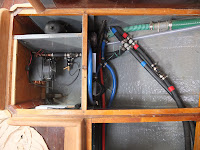 On Lively Lady it's been a bit of a slog to get all the systems installed but now there are real signs of progress which is just as well as time is slipping away so quickly. The Hydronic heater is now installed neatly in the engine bay and just about up and running apart from a few problems with air in the pipework. It's just like a home central heating system really with two fan assisted radiators (like car heaters) from Kurunda installed, one in the saloon and one in the forepeak. They're both connected to the tiny eberspacher heater unit using car heater hose and a gazzilion jubilee clips. You can just see one of the blowers on the right under the port bunk all boxed in so that the air gets sucked in from the saloon ducted to the blower, nicely warmed up and out again. Can't wait for a chilly evening out on an anchorage to try it out for real!
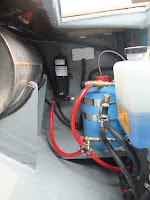 This is also where the domestic pressurised water pump, the accumulator to smooth out the flow and the piping for the tank has now been re-instated. It's been a bit of a faf to find sensible places to locate and fit everything in but this arrangement seems to work alright. As the water tank has osmosis which will taint the water we've installed two filters under the galley, one standard one and a ridiculously expensive one that's apparently guaranteed to take the taint out of the water. The remainder of the installation is in the forward end of the sail locker where the little calorifier (the blue hot water tank in the photo on the right) sits at the bottom surrounded by pipework and ancillaries. I can't get over how many jubilee clips were needed, we're now over 100, I always seemed to be at the ABC chandlery next door to get more. At least there are plenty of drain and venting points which should help long term, hope they don't leak!

The other systems that have taken an age to install are the electrics. All the heavy current and charging equipment is now installed so the switch panel is live which was cause for celebration. On the left you can see the new battery boxes for the starting and domestic batteries, the 110 amp/hr battery here is paralleled up with another in the forepeak which should give us plenty of capacity. It's all industrial strength, fused and switchable to avoid any problems later on; hopefully this will all just stay under the covers and never need to see the light of day. Next it's finishing off the low current wiring from the panel and the NMEA network; the end is in sight!

The change of the seasons has been really noticeable, especially as the evenings are now so much longer. The geese seem to have noticed too, they were around in huge numbers a little while ago but have now left for the summer. It was quite difficult to concentrate on one day when there must have been a thousand or more geese feeding on some unfortunate farmers land adjacent to the yard. In desperation he set off a maroon to scare them away; it made a mighty crack and sent them all up in the air, at least for a while, an amazing sight!
It's just great to be back outside away from all the dust of the osmosis shed. It has been convenient to be under cover but now the hull is finished and watertight it's so much better to be outside. Even though the weather is rather cold and wet, at least most of the work to be done is down below. We're now on the far side of the other workshop in a sheltered position, and most important of all, adjacent to a power distribution panel to gain advantage from the work over Christmas installing the shore power system! The rain has washed away most of the dust leaving the hull sparkling after Bassie had done such a great job of polishing it a few days ago. At long last it's starting to feel like a yacht again now that it's more complete and after the removal of many of the boxes inside. The new instruments and compasses give her a very different feel outside, still traditional Contessa but updated.

The last big job got started this week, the removal of the floor which we'd left to the last. Naturally there was a bit of a horror story underneath but nothing that's been too difficult to remedy. The floor bearers have delaminated and are caked in baked on engine oil and dirt. It's now cleaned up, repaired, and with a new hatch making the area look like new; hopefully James will be able to give the floor itself the same treatment as well as strengthening it and tidying up the access panel surrounds. The countdown to re-launching in mid April is generating a sense of urgency now! there's too much to do and only a few days left so it's time to have a hard look at priorities and defer all the other things that can be done later when she's in Chichester.

On the positive side the galley really has started to come together. The corian top that's now in place complete with new fiddles all round looks both smart and practical. It may not be the cheapest way to go but we really wanted a change from tiles. Eggo has made a particularly neat job of the cold-box lid which fits snugly and the infill for the sink has a chopping board in the reverse side; a nice touch of luxury! The job now is to put in all the plumbing, connect those taps up and get the water system working.
 After much too-ing and fro-ing with the Registry of Shipping and Seamen we've finally got the name sorted out. As it's fully registered, not just on the small ships register, we've had to choose a unique name and most of the obvious ones have already been taken. After Shamal, Meltem, Lebeccio and Alize we just had to name her after a wind and Levante, a breeze that blows around Gibraltar sounded right. FIrst we tried four different spellings but they were all taken, then a few other more obscure winds, we were trying to resist the suggestion from the Registry folk that we add "of Chichester" to the name. None of this worked but we finally thought of "Lively Levante" which, we think, is particularly fitting for a Contessa and that proved to be unique and is now her name. With this critical decision behind us it's now possible to get on with all the other bureaucratic stuff like radio licences and the more interesting choice of the sign writing on the stern.
I
t's difficult to be immune from feeling the ups and downs that are inevitable with a restoration project like this, especially as this is now month 6 of what was intended to be a six month project. Fortunately there's no desperate need to get her into commission on a set date and things are steadily coming together. It's just that that phrase "everything takes four times longer than you think" keeps echoing in my head.

Progress on the electrics, which is the more interesting part of the project, has had to be put on the back burner while other things like making her watertight take priority. With the work on the bottom largely complete we've got to be ready for a move outside which would be less than ideal without any windows in place. We've been screwed up by screw sizes; the windows were shipped with ones that were never going to fit, much too short. The problem is that the inner fibreglass liner has sprung away from the deck moulding in places so some quite long screws are needed to pull them together, at least on a temporary basis. I ordered some A4 quality screws on the internet that were great price wise, arrived promptly but were the wrong length; fortunately ABC Marine next door had plenty in stock, I should have tried them earlier. Naturally, putting in windows is a two handed job, and my first offer of help had to be cut short due to the screw problems. Fortunately a good friend, Clive, jumped in at short notice and together we were able to make a really good job of installing them. I'll be very surprised if any water gets in after the care we took to get a really good layer of sealant in place all round all eight windows.
 The next priority has to be finishing off the engine compartment which also means fitting and commissioning the heating system. Once all this is done we can get the engine back in and put her back in the water. With time running out I left the engine clean up to Dale, the resident engineer who's been particularly helpful. Now that it's all cleaned up, repainted, serviced, and fitted out with new piping, it looks very different and ready to be the centre piece of the rebuilt engine bay.
Even though we only let Z-Spars know some of the final specifications a week or two ago the mast has now arrived all neatly wrapped in polythene and looks very good too. With new rigging and halyards it's going to make the Contessa look much smarter and, hopefully, will mean that we don't have any maintenance problems. Even better Richard has found a buyer for the old mast, it may not be much but saves the effort of chopping it up with an angle grinder and putting it in as skip! It does set another priority though, stripping off the winch and furling gear that we plan to re-use.

The one thing that we're totally dependent upon for the success of the project is the efficient operation of the burger van which provides delicious bacon baps at lunchtime that are indispensable to us all. Can you imagine the consternation when, just at the busy time, 1pm, the power failed and the hotplate went cold? We stared disaster right in the face. The burger lady was despondent as it was after 12 and she assumed that the workshop where the power was controlled would be locked up. Fortunately we're working in the workshop and even have some spare fuses; everyone has a moment of fame and that was mine, the day was saved and a smile came back on the burger lady's face!
Now that the last few areas of the hull are dried out it's time for the completion of the osmosis treatment which has resulted in the hull looking like it was when it was first built. The first step was to grind off the last of the last of the old gel coat around the skin fittings and edges of the skeg, the hull was then steam cleaned to drive out the contaminants that had accumulated with the moisture. Not surprisingly this highlighted a number of areas that had delaminated and needed to be rebuilt, apparently not many, but one did rather deep, almost to the bulkhead inside.

The top layer of fibreglass that had been peeled off earlier was then replaced by sheathing the hull with a layer of 400 gram biaxial cloth. A bit like wallpapering but needing great care and plenty of help as timing is critical, not for for the faint hearted! The epoxy resin has to be mixed up and applied quickly before it starts to set, the pre-cut sections of cloth are then laid over it and another thick coat rolled on. This is when Jim & Steve's years of experience pays off, it all went on first time without a hitch.

The following coatings have to be applied after the resin has gone off but not cured so that a chemical bond develops between the coats. First there's a layer of gel shield then the filler followed by more gel shield. Putting the filler on is like plastering, it's spread thinly over the cloth filling up all the indentations; several layers are needed in some places to achieve a consistent smooth surface, all done by eye. It will take several days to cure and as there are no supports it's not possible to work on the interior, result: a weekend off!
With little to do I've been casting around on the net to see what other people are doing and came across a really interesting note "Fundamentals of Restoration Projects" by David Pascoe (http://www.docksidereports.com/fundamentals_of_restoration_proj.htm). He's a surveyor that has clearly seen more than a few yachts being restored; some successfully and some less so. His insight is amazingly accurate, wish I'd read this before starting the Tipsea2Levante project. "Automatically understand that every job takes 4 times longer than you thought it would" is typical of his views, it's jam packed with insights that I've had to learn the hard way and thoroughly endorse. Strangely it's comforting as I've ended up doing most of the key things he considers important such as making the engine compartment a central feature of the restoration despite the effort involved. He suggests that "highly desirable" yachts with that "something boaters love" are the only ones worth this level of attention; I think that the Contessa falls into this category, or certainly hope so...
Having to finalise the specification for the new mast prompted a reflection on how we came to make our choice which is certainly a topic of conversation on forums. Initially we'd hoped to be able to use the original mast with a bit of patching to cover the wear at the partners but corrosion underneath the fittings condemned it to scrap. We feel more than a bit peeved that the surveyor didn't report it as this is quite obvious now and we should have been able to negotiate a price reduction.

Nevertheless there are advantages in a new mast, it should be trouble free for our ownership, look better and keep the water that was cascading in, out. The obvious choice for a Contessa is a Selden mast, the company who bought out Kemp, the original supplier. They're big, with a lot going for them, but not inexpensive. The main alternative turned out to be Z Spars who seem to offer all that's needed for a predominantly cruising yacht and were prompt and efficient. I seems just like buying a car, the initial base price is not too painful but the extras mount up ever so quickly not to mention delivery and fitting. We don't want to have to get up the mast to fix things so a new VHF aerial and lights aren't optional. We've also chosen to have an inner stay and lazy jacks so care had to be taken to make sure the halyards and cleats would be adequate. The prices for the Z Spar we specified turned out to be significantly lower than Selden which makes quite a difference although we spent some of this on a new spinnaker pole! We've now carefully checked all the dimensions and specifications (all very fiddly & time consuming!) by comparison with the old mast, confirmed the order and are awaiting delivery. It will be interesting to see how the installation goes and see if there are any issues arising from the re-use of the original Hood furling mechanism. Everyone seems to be rather keen on selling masts so there must be quite a bit of margin in it for them; shame they don't all separate their services from mast sales. It seems a bit anti-competitive that some riggers are only prepared to fit masts they've supplied or maybe they just have lots of business on the go and can pick and choose.
The final dimensions of the blade to go on the inner stay have now been agreed with Ivan of Arun sails after numerous phone calls to get them right. A custom fitting to support the stay which will pass through the deck and onto the forward bulkhead (forming part of the anchor locker) is being made up. We're also having some fittings made up that will attach to the main bulkhead between the heads and the forepeak to allow some dedicated blocks to be fitted enabling the sail to be set up without taking the headsail down. The foot will be 1.9m long so the sail will be somewhere between a No3 Jib and a storm sail which, conveniently, is just about what we wanted. When the wind pipes up in future we'll be ready for it!

Work on the interior is progressing well too, the galley is nearly finished and much of the electrical equipment is now in place. It all fitted in rather well and should be quite accessible either behind the instrument panel or under the pilot berth by the batteries. What has been quite amazing is the amount of wire that's disappeared into the hull, almost 100 meters! Clive reckons that will be enough to sink the boat; I hope not but I'm not so sure that this and all the other kit installed will do much for speed in light airs!

There's been a change of scenery in the Osmosis Shed with a shuffle round to let some boats out and a couple of new ones in. Our Contessa now has another for company named Bugle, also there to have it's hull treated for the dreaded boat pox. After a pause whilst several other rather larger boats were treated, Jim and Steve, the osmosis team, are getting ready to re-coat the hull once it's fully dry. There are a few areas around the stern that still have high levels of moisture so the lamps are on them to dry them out which should be complete in a week or so. They're about to work on the Westerly in the foreground any time now and when that's complete they'll get started on our yacht which will take about a week to complete. During this time the props will be taken away so there'll be no access or work on board for a week until it's cured. There will then be another round of musical chairs and, with a bit of luck, we'll end up in the other shed for a few weeks whilst the GRP work is finished off.
 It's amazing what a difference a couple of weeks can make, the galley is looking very different, the bilge pump and been moved allowing the gas locker to be re-instated and the water system is starting to take shape. Paul's fitted some new plywood panels to make up an outer surround for the cold box and put the spacious inner liner that's been specially fabricated in place. There's about an inch and a half gap all round that's now filled with foam which should be good enough as insulation but we'll add a bit more on the outside where we can. Initially I was surprised by the number of hours quoted for the job. Now it's clear why they were needed, it's a fiddly job, especially the new gas pipework. It's satisfying to see it all coming together as planned, the cold plate is unobtrusive and the compressor unit fits amazingly well in the space behind the cooker. All we're waiting for now is the Corian top that Eggo is preparing based on the ply top that's already cut out for the sink and taps. Can't wait to see it in place!
I've managed to complete a variety of time consuming jobs that have to be done before work can progress including the forward battery plinth and the base for the calorifier. I'm also rather relieved that I've been able to run the NMEA cable up from the nav area to the coach roof without difficulty. The acrylic has arrived so the instrument pod is ready to accept the instruments as soon as the 90mm cutter arrives. With so much stuff now installed it's been possible to have a good clear out of the interior and tidy up. The recycling bin is now full of cardboard and all those bits that wont get used such as the old galley top taken to the skip. It all looks so different, some way towards being a yacht again!


